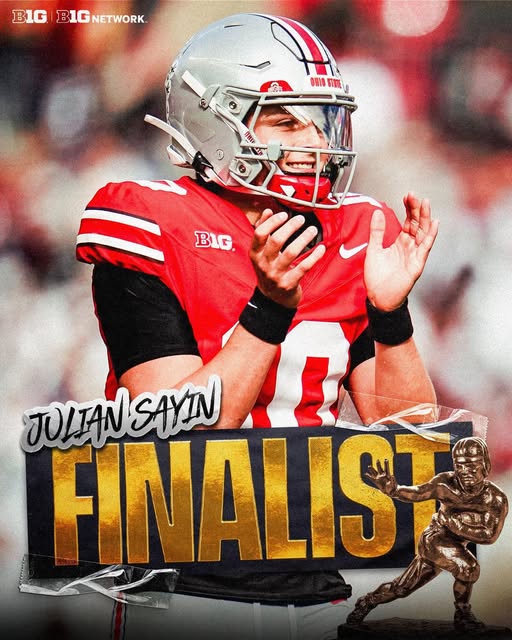
Julian Sayin being named a Heisman finalist is no surprise; in truth, it has felt inevitable ever since he took over as Ohio State’s starting quarterback this season. On December 8, 2025, the Buckeyes officially confirmed that Sayin landed among the four finalists for the Heisman — a group that also includes Fernando Mendoza of Indiana, Diego Pavia of Vanderbilt, and Jeremiyah Love of Notre Dame.
Sayin’s résumé this season is nothing short of extraordinary. According to Ohio State’s official stat lines, he leads the entire nation in completion percentage, completing passes at a staggering rate of 78.4%. His passing efficiency rating — another key metric for quarterbacks — is among the highest across FBS, giving him the statistical edge over virtually every other signal-caller in college football today. In concrete numbers, over the course of the season Sayin has thrown for well over 3,000 yards and has amassed more than 30 touchdowns, with only a handful of interceptions.
But the case for Sayin extends beyond raw numbers. What stands out is his poise and maturity — especially remarkable given that he is a redshirt freshman and in his first full season as a starter. In marquee games when the spotlight was brightest — including a crucial rivalry matchup against Michigan Wolverines — Sayin responded like a veteran. In the Michigan game, he passed for 233 yards and three touchdowns with just one interception, guiding Ohio State to a dominant 27–9 win and breaking a multi-year losing streak in that rivalry. SI+1 Many teammates and analysts didn’t hesitate to voice their support. As one Buckeyes defender put it when asked if Sayin should win the Heisman: “I mean, duh.”
Add to that the historical pedigree of Ohio State in the Heisman conversation. The Buckeyes have had six previous Heisman winners, though none since 2006. Over the past several seasons, Ohio State has consistently produced finalists under head coach Ryan Day, and Sayin continues that tradition. Some see his being selected as a finalist — as a first-year starter — as a strong indication the Heisman electorate recognizes elite performance even early in a career.
Therefore, many believe Sayin has a real shot at the trophy this year. His efficiency, production, and ability to perform under pressure make a compelling case. If voters value those traits — and if Ohio State finishes deep in the College Football Playoff — Sayin could very well break Ohio State’s Heisman drought.
Yet, it is important to recognize the obstacles in his path. The most glaring is that this year he is not the only elite candidate — and perhaps not even the leading one. His main competition among the finalists, Fernando Mendoza, delivered a standout season for Indiana Hoosiers, leading them to an undefeated regular season, a conference championship, and — in many eyes — the top seed going into the postseason playoffs.
Moreover, in the decisive conference title game — a chance for Sayin to cement his candidacy — Ohio State fell to Indiana. That loss, and Mendoza’s performance in that spotlight game, likely shifted voter momentum. Historically, Heisman voters tend to reward players who not only post big numbers, but who lead their teams to championships or signature victories in big games — especially late in the season. The Buckeyes missing the Big Ten crown removes a key narrative for Sayin.
Another factor working against him: while Sayin’s numbers are elite in passing efficiency and accuracy, he is not particularly dangerous as a runner. That limits his upside compared to dual-threat quarterbacks or running backs who contribute heavily in multiple facets of the game. Some analysts have noted that this makes his statistical profile more “clean” but perhaps less flashy.
Finally, there is the question of narrative fatigue. Ohio State produces Heisman finalists with some regularity; over the last eight years, the Buckeyes have had multiple finalists and near winners, yet the school still hasn’t secured a Heisman winner since 2006. Voters — media and experts alike — may unconsciously lean toward rewarding “fresh faces” or players from schools or programs with less recent Heisman exposure. In that sense, Sayin’s Ohio State pedigree and the program’s recent Heisman-finalist history could work against him as much as for him.
All that said, if you step back and look at the full picture, there’s an argument that Sayin deserves to win the Heisman this year. He combined elite efficiency, maturity, and consistent excellence under pressure. He guided Ohio State to a brilliant 12-1 regular season and a top seed in the playoffs. He played like the next great Buckeye quarterback — confident, precise, and poised.
In the end, whether he wins may come down to what Heisman voters value most: raw efficiency and statistical dominance, or a narrative punctuated by championship victories and late-season heroics. If they value the former, Julian Sayin should be right in the mix. If they value the latter, this year may end up being his “what could have been” moment. Even if he does not take home the trophy, being a finalist as a redshirt freshman at Ohio State is a huge signal: he has not only arrived — but might be a force to be reckoned with in the years ahead.