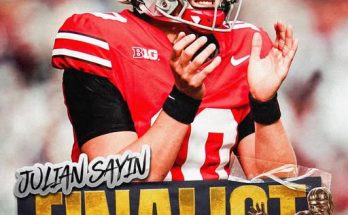
Who’s taking home the Heisman this year? It’s a question that’s got college-football people buzzing — and as a sports journalist, I’ve got my eyes locked on Julian Sayin. The young signal-caller for Ohio State Buckeyes has a real shot at the 2025 Heisman Trophy — but as with all great races, there are bumps in the road. Here’s why Sayin is very much in the mix… and what could stop him (or others) from lifting the hardware.
From the moment Sayin took over as Ohio State’s starting quarterback, the hype started — and it hasn’t let up. This season he’s been nothing short of remarkable. According to Ohio State’s own announcement, Sayin leads the entire FBS in completion percentage (78.4 %) and in passing efficiency, posting numbers that eclipse NCAA averages and rival any elite quarterback’s season. That kind of statistical dominance alone demands attention from Heisman voters.
On top of that, he’s shown consistent big-game output. He’s tied for the most games this season with at least 300 passing yards and three passing touchdowns, and tied nationally for most 30-plus yard passing touchdowns. That kind of “explosive but clean” performance — long touchdowns, efficient drives, few turnovers — tends to shine under the Heisman spotlight. Add to that the fact that Ohio State went 12–0 in the regular season with Sayin under center and earned the No. 2 seed in the College Football Playoff, and you get a narrative of a first-year starter shouldering a historic offense.
Another point in Sayin’s favor: he’s doing all this as arguably the least experienced among the top contenders. As a redshirt freshman and first-year starter, he brings a storyline — breakout season, meteoric rise, youthful poise under pressure. That kind of narrative tends to resonate with voters (and fans). Some analysts and insiders think that could give him an edge.
And it’s not just outsider noise — many of his teammates are firmly in his corner. Ohio State wide-out Jeremiah Smith has publicly picked Sayin as his preferred Heisman winner, while defensive standout Caleb Downs even went as far as to say that “they could just give it to Ohio State [as a whole], name two people as Heisman.” There’s clearly belief within the program that Sayin deserves it — and when your own locker room is lobbying for you, that counts for something.
Beyond the locker room, national analysts are paying attention too. For instance, former Heisman winner Robert Griffin III recently put Sayin atop his Heisman list, citing his near-unbelievable accuracy and production — particularly after a gaudy outing against Penn State.
So on raw talent, poise, stats, and narrative — Sayin absolutely belongs in the Heisman conversation, among the top names vying for the award this season.
Still — as with any high-stakes race — there are factors working against him. And given the strength of the field, his path to the trophy is by no means guaranteed.
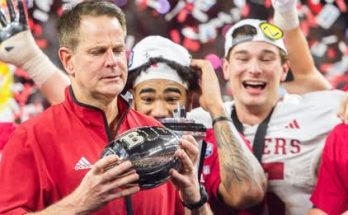
Perhaps the most obvious challenge: there are other standout candidates competing for the same honor, and one has momentum on his side. Fernando Mendoza of Indiana Hoosiers has emerged as a heavy favorite — especially after leading Indiana to a perfect regular season and a Big Ten Championship berth. Betting markets reflect that: some sportsbooks list Mendoza right alongside or even ahead of Sayin.
Why Mendoza is tough to beat: not only has he racked up big passing numbers, but he and his team have crafted a narrative of overachieving — Indiana isn’t traditionally a college-football powerhouse, yet under Mendoza’s leadership, they’ve stunned expectations. Voters often like a “rags-to-relevance” storyline. Meanwhile, a central criticism of Sayin: some believe that because Ohio State is stacked with talent — receivers, offensive line, depth — it dilutes his individual “heroic quarterback” narrative. As one analyst put it, Sayin is “efficient, clean, and technically superior” — but maybe without enough drama to sway voters in a race that often rewards theatrics.
Let’s not forget about the team results, too. The Heisman doesn’t always go to the stat-leader; it often goes to someone whose team excels, captures headlines, and builds a story voters remember. While Ohio State was undefeated in the regular season, they lost in the conference title game. That loss could dampen the sheen on Sayin’s campaign, especially if a rival contender finishes with an unblemished record or clinches a major championship.
There’s also the risk of internal vote splitting. With Ohio State having multiple standout players — not just Sayin, but weapons like Jeremiah Smith, defensive stars, support from the offense — some voters might privilege a different Buckeye (or simply opt for someone outside OSU entirely). That internal star-power could end up diluting Sayin’s vote share. As one fan post put it: “I’m worried this will be yet another year where we have too many excellent players and therefore split the vote.”
(On that note: on Reddit’s Ohio State-focused forums, you’ll find a similar mix of hope and caution. One user wrote:
“If Ohio State and Indiana keep winning there is a great chance more than just the B1G title and overall 1 seed will be on the line.”
Another:
“I hope sayin doesn’t get ripped off by the Heisman voters this year. If we go undefeated, beat number 2 Indiana in the Big Ten championship, and sayin continues to play like he is now there is no reason to not give him the award.”
But also reasonable skepticism:
“I think [voters] will be looking for some ‘Heisman moment.’ Stats alone don’t always win it.”
All of which underscores how unpredictable the final vote can be.)
Beyond competition and narrative, there’s also the broader context of Heisman history and voter biases. Historically, sometimes the flavor-of-the-month — the compelling underdog story, the unlikely breakout — gets rewarded more than consistent excellence on a stacked team. With Sayin playing in a powerhouse program, some voters may subconsciously (or consciously) look elsewhere for “the story.” That’s not to say Ohio State doesn’t get national respect — but that respect can cut both ways: dominance can be compelling, or it can be “expected,” and that expectation may dilute the emotional impact of his season.
Another external factor: voters often want a “defining moment.” A single game, a jaw-dropping play, a comeback — something to crystallize the narrative in memory. Reidining a top-tier season needs more than numbers; it needs drama. Critics argue Sayin’s Buckeyes have too consistently steamrolled opponents. That kind of dominance — absent dramatic adversity — can sometimes work against the “underdog + hero” instincts many voters have. SI+1
And finally: there remains unpredictability. Injuries, a bad game, unexpected slips — football is messy. A small misstep could derail the clean-sheet story. Or another contender could explode in a bowl game or playoff run, swaying late voters.
Even if Sayin doesn’t win, there are other candidates in the mix: as the finalists list shows, there’s also Diego Pavia of Vanderbilt Commodores and Jeremiyah Love of Notre Dame Fighting Irish — each offering a different style and narrative that could resonate. Pavia brings a dual-threat dynamic and a story of revitalization at a lesser-celebrated program; Love offers the classic wunderkind running back dominance story.
That means the Heisman voters have tough choices. Do they reward elite accuracy and consistent performance on a monster team (Sayin)? Do they reward the Cinderella-style rise of an underdog school (Mendoza or Pavia)? Or the old-school all-purpose workhorse dominance (Love)?
At the risk of playing hype-man, here’s why I think: if Sayin closes the season clean — if he leads Ohio State to a decisive bowl/Playoff win, strings together 300+ yard games, 3+ TDs, minimal turnovers — he’ll make his case impossible to ignore. That kind of finish could tilt enough ballots his way.
Still, Heisman races are seldom decided on logic alone. They’re about story. About impression. About what stays in the mind when the ballots are being cast. And in 2025, that story may favor the underdog, the poet-laureate of collapse-to-glory, or the breakout sensation — not necessarily the disciplined, efficient standard-bearer.
For that reason, even as I tip a hat to Julian Sayin, I’m watching the others closely: because in the Heisman game, talent gets you invited — but momentum wins the trophy.
So — who’s taking home the Heisman? My bet: it’s still Sayin — but only if he finishes strong, delivers on the biggest stage, and gives voters a reason to crown him not just the most efficient, but the most memorable.
If that doesn’t happen… I wouldn’t be surprised if the trophy ends up somewhere else.