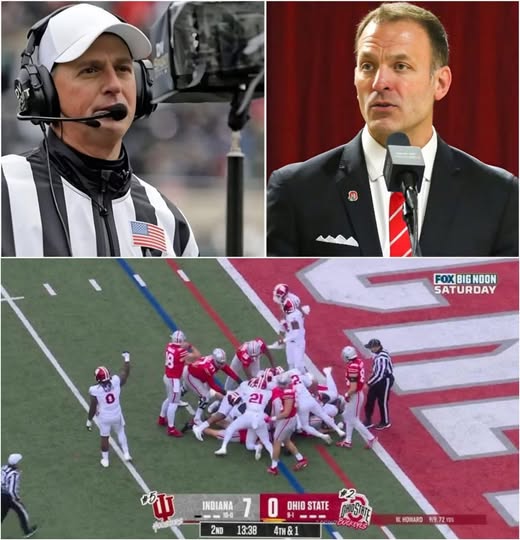
The fallout from the controversial finish of the Ohio State–Indiana matchup has now spiraled far beyond the boundaries of a single officiating error, igniting a national debate about accountability, transparency, and the NCAA’s persistent struggle to maintain public trust. What began as a tense final sequence in a high-stakes Big Ten contest has evolved into a full-scale public reckoning, with veteran referee Ron Snodgrass issuing a rare post-game apology that has only intensified the frustration and outrage among Ohio State fans, players, and administrators. The reaction from Columbus has been swift and unwavering, culminating in OSU Athletics Director Ross Bjork releasing an official statement condemning the officiating inconsistencies and demanding structural reforms. As the controversy widens, it has drawn attention from analysts, coaches, and former officials nationwide, all weighing in on whether Snodgrass’ mea culpa is a meaningful step toward accountability or a symbolic gesture that leaves deeper issues unresolved.
Snodgrass’ apology, delivered nearly 24 hours after the conclusion of the game, came after extensive review of the final minutes of play, including a sequence that many analysts have already described as one of the most egregious officiating breakdowns of the season. His statement acknowledged “regret” for the decisions made on the field and admitted that crucial calls were either misinterpreted or incorrectly communicated among the officiating crew. In ordinary circumstances, such an acknowledgment from a longstanding referee might have been viewed as admirable transparency. But the intensity of this particular moment, the magnitude of the stakes, and the already simmering tension surrounding NCAA officiating standards transformed the apology into a fresh source of anger rather than a balm for OSU’s frustration.
From the moment the final whistle blew, Ohio State’s coaching staff and players appeared stunned by the officiating errors that shaped the closing moments. What should have been a routine sequence instead devolved into chaos, marked by a controversial spot, an ambiguous pass-interference no-call, and a subsequent replay decision that fans and analysts have struggled to rationalize. Social media erupted within minutes, with slow-motion videos dissected frame by frame, and former referees offering commentary that only reinforced the perception that significant errors had occurred. By the time Snodgrass’ apology surfaced, the public had already formed a strong consensus: the officiating crew’s performance had materially influenced the outcome, and an apology was not nearly enough.
Inside Columbus, the sentiment hardened quickly. Ohio State players spoke with visible frustration after the game, choosing their words carefully but making clear that they felt robbed of both momentum and fairness. Several players privately expressed that the apology felt hollow, emphasizing that the damage was already done. The emotional toll of the loss, paired with the sense of injustice, reverberated throughout the locker room. Coaches reviewing the footage afterward reportedly confirmed the players’ reactions, noting that the officiating missteps were not matters of interpretation but clear departures from protocol.
This cumulative pressure forced Athletics Director Ross Bjork to step forward with a firm and meticulously crafted statement that underscored the gravity of the situation. Bjork’s statement, released publicly through Ohio State’s athletics department, emphasized that the university respects the difficulty of officiating and the human element inherent in collegiate sports. Still, it articulated the program’s “deep concern” over the decisions made in the Indiana game and the NCAA’s broader shortcomings in ensuring officiating consistency. While measured in tone, the message was unmistakably pointed. Bjork called for a formal review of the officiating crew’s performance and pushed for more transparent processes to evaluate officials after high-impact games. He also urged that the NCAA commit to reforms that increase training, accountability, and technological integration.
The NCAA, for its part, has not yet responded in detail, though sources close to the organization suggest that internal conversations have already begun. Historically, the NCAA has been reluctant to admit officiating faults publicly, preferring internal review processes that avoid assigning blame to individuals. But the sheer volume of public criticism in this instance—and the prominence of the programs involved—could pressure the organization into a more overt acknowledgment. Analysts have noted that the NCAA faces increasing scrutiny from both fans and media regarding officiating standards, especially as replay technology has evolved and expectations for accuracy have risen. The idea that crucial errors can persist despite multiple cameras and review angles has become a flashpoint in discussions around officiating competence and reliability.
Snodgrass himself has long been considered a seasoned official with a reputation for composure and rule knowledge, which makes this controversy all the more notable. His apology described the mistake as a “momentary lapse” and cited the speed of the play and the crew’s on-field communication challenges. Yet critics argue that the apology implicitly reinforces well-documented systemic issues, including inadequate oversight, uneven enforcement of rules across conferences, and insufficient penalties for officiating failures. While officials are often shielded from public criticism by league protocols, this incident has thrust the officiating world into the spotlight in a way that may be difficult to reverse.
The broader sports world has reacted swiftly. Numerous analysts across national networks have weighed in, with many applauding Snodgrass’ willingness to acknowledge mistakes but simultaneously arguing that apologies have little value without visible consequences. Former officials have offered mixed perspectives: some defend Snodgrass and emphasize the unrelenting pressure officials face, while others see the apology as a necessary, if incomplete, step toward restoring credibility. Fans, however, appear nearly unanimous in their skepticism. For Ohio State supporters, the apology serves as a painful reminder of what they feel was taken from them—a fair shot at victory—and as a symbol of the NCAA’s extended failure to address inconsistencies that have plagued the sport for years.
The timing of the controversy also adds complexity, with the college landscape undergoing sweeping changes around name-image-likeness reform, conference realignment, and debates over student-athlete compensation. Amid these transformative pressures, the NCAA can ill-afford another crisis that casts doubt on its ability to govern the sport effectively. For many observers, the officiating controversy is emblematic of an organization stretched thin, struggling to keep pace with the modern expectations of transparency, fairness, and professional standards.
Within the Ohio State community, the conversation has expanded beyond anger and toward advocacy. Alumni groups have begun circulating petitions calling for standardized national officiating protocols across conferences. Some boosters have pushed for retiring certain officials or requiring more rigorous certification processes. Others have urged the adoption of NFL-style “officials grading transparency,” in which weekly evaluations are made public and errors are formally acknowledged. Whether these proposals gain traction remains to be seen, but they reflect a turning point: fans no longer accept officiating mistakes as an inevitable part of the game. They want assurance that errors will be addressed, prevented, and held accountable.
Coaches around the Big Ten have quietly voiced their own frustrations, though most have done so off the record to avoid league penalties. Still, it is widely understood within coaching circles that officiating quality has been uneven this season, and the Snodgrass incident has given voice to long-standing concerns suppressed by fear of reprisal. One coach, speaking anonymously, indicated that the issue is not isolated, describing frequent confusion over replay criteria, inconsistent interpretations of pass interference, and overly subjective decisions on player safety calls. “It’s reaching a breaking point,” the coach said, suggesting that the fraternity of coaches across major conferences is more unified than ever in demanding reform.
The players, too, are increasingly vocal about the need for higher officiating standards, especially in games that carry playoff implications and career-defining moments. For many athletes, the stakes are enormous—NFL scouting evaluations, award considerations, team rankings, and legacy status all hinge on fair outcomes. When officiating errors cast shadows on these efforts, the psychological impact can be profound. Several OSU upperclassmen privately expressed that they felt their hard work had been overshadowed by decisions they could not control. The emotional strain of that sentiment is likely to linger throughout the remainder of the season.
From a broader cultural perspective, the Snodgrass incident underscores a growing shift in how sports audiences engage with officiating. The proliferation of high-definition broadcasts, replay technology, and instant online commentary has created a more informed and critical fanbase. Mistakes that may have gone unnoticed decades ago now unfold under a microscope, replayed endlessly on television and social media. While this visibility can promote accountability, it can also make the role of officials more challenging than ever. Yet the evolving landscape only heightens the need for procedural clarity and system-level reforms—areas in which many believe the NCAA has lagged.
As for Snodgrass, his future remains uncertain. While no formal disciplinary measures have been announced, the intense public scrutiny has cast doubt on whether he will be assigned to high-profile games in the near future. Officiating experts speculate that the NCAA may temporarily sideline him during the review, though such decisions are typically made quietly and without official comment. Regardless of his future assignments, the incident will likely follow him for years, shaping how fans perceive both his performance and the broader officiating community.
The NCAA now faces a decision that will shape public confidence: whether to treat Snodgrass’ apology as the conclusion of the issue or as the beginning of a broader reform initiative. If history is any indication, the organization may opt for behind-the-scenes evaluations rather than public discourse. But the intensity and scale of the backlash suggest that this situation is different. Ohio State’s formal involvement, Bjork’s forceful statement, and the overwhelming public scrutiny may force a more transparent and public response.
For now, the controversy remains unresolved, its implications rippling outward across college athletics. Snodgrass’ apology, intended as a gesture of remorse and accountability, has instead become a catalyst for deeper conversations about fairness, integrity, and the future of officiating at the collegiate level. Ohio State’s frustration remains unabated, the NCAA faces renewed pressure to modernize, and fans across the country are watching closely to see whether this moment becomes a turning point—or another missed opportunity for meaningful change.