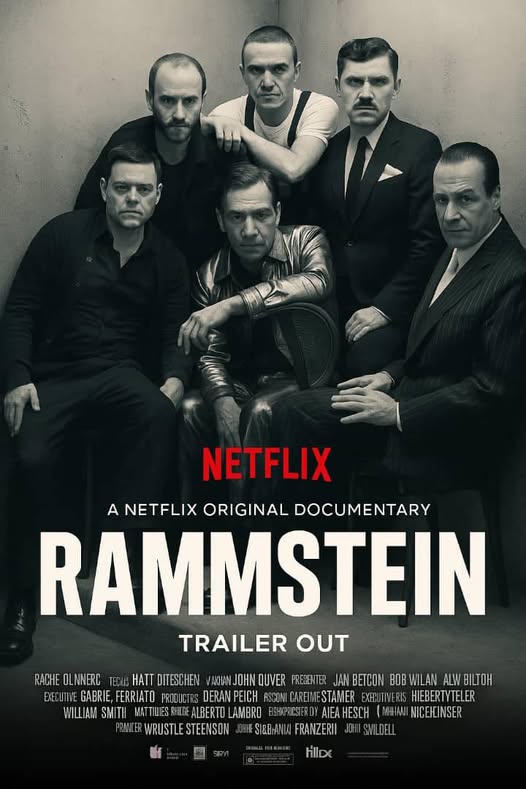
For decades, they have been a phenomenon shrouded in a haze of pyro-smoke, industrial riffs, and Teutonic enigma. Rammstein’s music, a brutalist cathedral built on the foundations of Neue Deutsche Härte, has always been an experience that transcends mere audio. It is a visceral assault, a spectacle of fire and fury that has earned them a reputation as the most dangerous, controversial, and utterly uncompromising live act on the planet. We thought we knew them. We thought we understood the pact: we bring our earplugs and a capacity for shock, and they bring the flame-throwing masks and the giant cauldron of foam. But we were wrong. The explosive Netflix documentary, simply and powerfully titled *Rammstein: Paris*, pulls back the steel curtain not to demystify, but to re-mythologize, and in doing so, reveals a shocking truth we were never prepared to see.
This is not a conventional documentary. There are no talking heads, no sepia-toned childhood photos, no earnest interviews dissecting the meaning behind “Du Hast.” To approach Rammstein in such a manner would be to fundamentally misunderstand their art. They are not a band that explains; they are a band that *is*. Directed by Jonas Åkerlund, a visionary filmmaker with a pedigree in music video iconography (Madonna, Lady Gaga) and a past steeped in punk metal chaos (Bathory), the film is a relentless, sensory-overloading immersion into the heart of their 2012 concert at Paris’s Bercy Arena. It is an attempt to capture the uncapturable: the sheer, physical, and psychological force of a Rammstein performance.
The most immediate and shocking revelation is the perspective. Åkerlund, armed with a staggering array of cameras—from sweeping cranes that glide over the seething crowd to microscopic lenses nestled amidst the drum hardware and the grime-smeared stage floor—places you *inside* the machine. You are no longer a spectator in the stands; you are on the stage with Till Lindemann as he stalks the platform like a caged U-boat captain, his face a topography of grimaces and intensity. You are looking out from behind Christoph Schneider’s drum kit as a wall of sound and light crashes into 17,000 people. You are in the pit, feeling the heat of the flames lick your face during “Feuer Frei!” This intimacy is jarring. It shatters the comfortable distance we maintain as audience members. We see the sweat, the strain, the sheer physical labour involved in creating this controlled chaos. We see the focused, almost surgical precision in the eyes of Richard Kruspe and Paul Landers as they execute a complex guitar passage mere moments before triggering a jet of fire from their headstocks. The danger is no longer an abstract concept; it is a palpable, sweaty, and terrifyingly real presence.
This unprecedented access forces a re-evaluation of the band members themselves. The stoic, near-silent titans of the stage are revealed as master craftsmen. The shocking truth is not one of backstage debauchery or petty squabbles, but of profound, almost obsessive professionalism. The film meticulously deconstructs the spectacle to show the intricate clockwork beneath. We see the labyrinth of wires snaking across the stage, the military-grade flamethrowers being calibrated, the complex choreography of the crew who operate as a silent, efficient army. A sequence focusing on the performance of “Mein Teil” is particularly telling. What appears from the audience as a demonic ritual featuring a giant cauldron and a butcher-knife-wielding Till becomes, through Åkerlund’s lens, a breathtaking feat of engineering and timing. The shock value of the song’s subject matter (the Armin Meiwes cannibalism case) is secondary to the shock of seeing the immense technical collaboration required to bring its theatrical representation to life. The band is not just performing; they are conducting a symphony of fire, steel, and raw power.
Furthermore, the documentary reveals the surprising vulnerability and, dare we say it, the artistry beneath the hardened exterior. There are moments of quiet intensity that are as powerful as any explosion. A close-up on Flake Lorenz, the band’s enigmatic keyboardist, as he pedals his bizarre, custom-made treadmill keyboard during “Keine Lust,” reveals not a caricature of oddity, but a man lost in the rhythm, his face a mask of singular concentration. In these unguarded moments, the members of Rammstein cease to be monolithic icons and become what they truly are: six intensely focused individuals who have perfected a unique and dangerous form of communication. The film highlights their synchronicity, the unspoken language of glances and nods that keeps the entire precarious enterprise from collapsing into a fiery disaster.
Perhaps the most profound truth the documentary uncovers is the symbiotic, almost sacred relationship between the band and their audience. Åkerlund’s camera does not shy away from the crowd. He films them with the same reverent, hyper-detailed lens he uses on the band. We see the ecstatic, tear-streaked faces of fans, the sea of raised fists moving in unison, the collective intake of breath before a pyrotechnic crescendo. The film argues that a Rammstein concert is not a performance *for* an audience, but a ritual *with* an audience. The energy flows in both directions. The band’s aggressive, often misunderstood music—with its themes of love, pain, authority, and transgression—becomes a cathartic release for the thousands gathered. The shocking truth is that the “danger” is not merely a gimmick; it is the necessary, raw edge that makes this catharsis possible. It is the shared risk, the collective endurance of the overwhelming sound and heat, that forges a temporary community in the dark.
Of course, the film is also a testament to pure, unadulterated spectacle. The concert footage, remastered and presented with a sonic clarity that feels physically oppressive, is breathtaking. “Sonne” has never seemed more like a hymn to a dying star, and “Engel,” with its giant, mechanical wings and fake snow, achieves a level of theatrical grandeur that borders on opera. Åkerlund uses every trick in the cinematic playbook—slow motion, rapid-fire montage, disorienting angles, and a colour palette that veers from hellish reds and oranges to cold, clinical blues—not to embellish, but to translate. He understands that a standard multi-camera shoot could never convey the experience, so he builds a new, cinematic language to do it justice.
In the end, *Rammstein: Paris* is a shocking revelation not because it exposes some sordid secret, but because it dismantles our preconceptions and forces us to look deeper. The truth it reveals is that Rammstein is not a band that hides behind pyrotechnics; the pyrotechnics are an integral, linguistic part of their art. They are not careless provocateurs; they are meticulous artists of provocation. The danger is not an accident waiting to happen; it is a carefully calculated element of their aesthetic. By taking us closer than we have ever been, the documentary shows us that the true power of Rammstein lies not in the fire itself, but in the intense, human focus required to control it. You have never seen Rammstein like this before because you have never been *this close* to the heart of the inferno. And once you have, you will never hear the roar of the crowd or the blast of a flame the same way again.