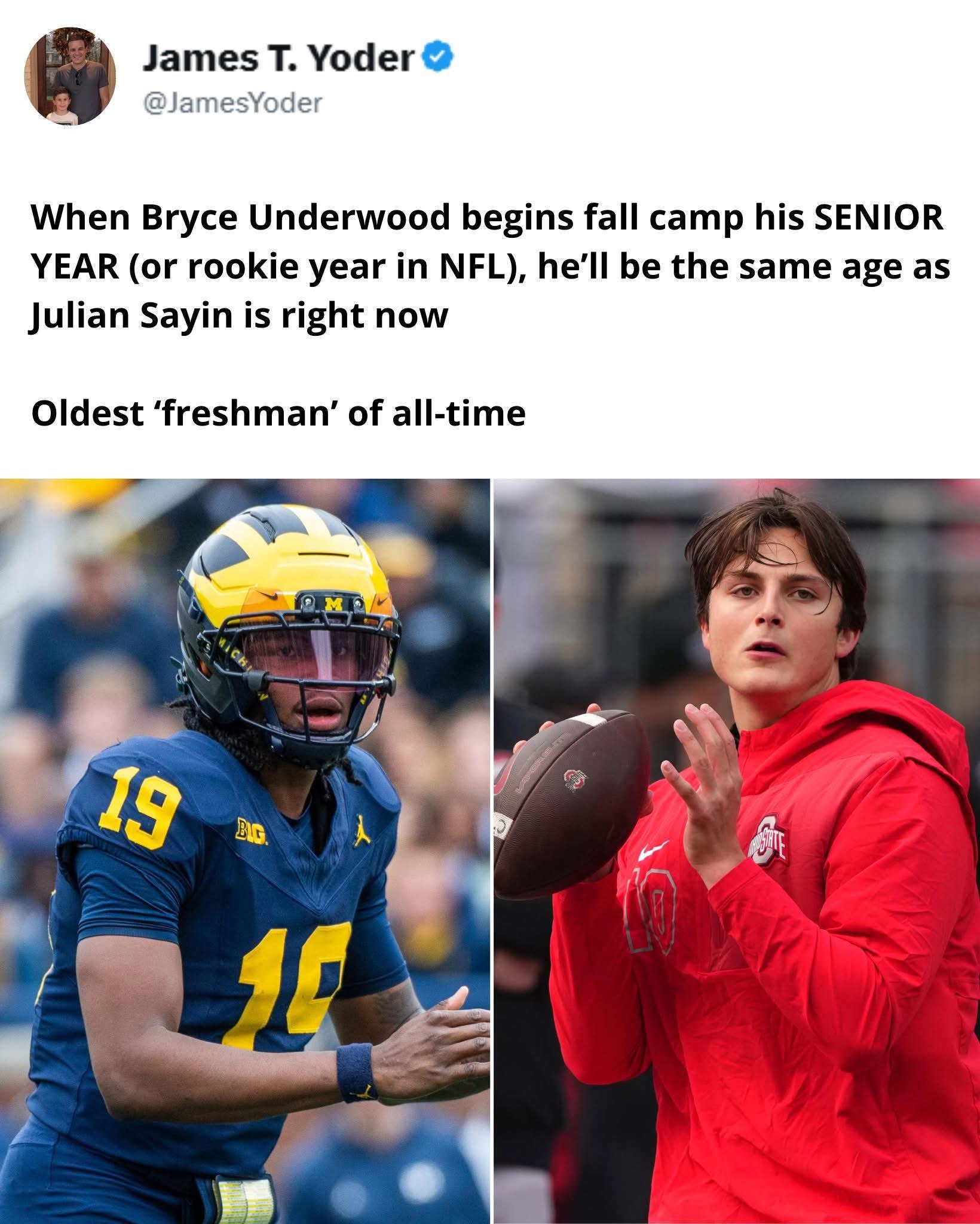
Bryce Underwood hasn’t even taken his first collegiate snap yet, but somehow he already carries himself like the seasoned veteran who’s seen everything, done everything, and is politely waiting for the youngsters to catch up. Among a class of wide-eyed freshmen just learning the rhythms of college football, Underwood stands out not just for his arm talent or five-star status, but for the uncanny way he moves, speaks, and prepares like someone who’s been in the building for years. That’s why teammates, fans, and now the internet have landed on a hilarious but strangely accurate description: Bryce Underwood is basically a grandpa among freshmen.
It starts with the way he carries himself. While most incoming players are buzzing with nervous energy, bouncing around facilities like kids on a field trip, Underwood has the calm demeanor of someone who knows exactly where he’s going and why he’s there. He doesn’t rush. He doesn’t force moments. He doesn’t need to announce himself. He walks into a room with the quiet confidence of a quarterback who understands that leadership isn’t about volume, it’s about presence. In a locker room filled with teenagers fresh out of high school, that alone makes him feel older than his birth certificate suggests.
Listen to him talk and the comparison becomes even funnier. Underwood doesn’t lean heavily on clichés or sound bites. He speaks deliberately, choosing words carefully, answering questions with thought rather than flash. There’s a patience in the way he explains reads, coverages, and preparation that feels more like a junior or senior than a first-year player. When asked about pressure or expectations, his answers don’t drift toward hype or outside noise. Instead, he talks about process, daily improvement, and accountability. That’s quarterback dialogue straight out of a veteran’s playbook.
Part of that comes from his football upbringing. Underwood hasn’t just been talented; he’s been groomed. Years of elite training, national attention, big games, and constant scrutiny have accelerated his football maturity. He’s been the focal point of teams, scouting reports, and recruiting battles since he was barely old enough to drive. When you’ve been dissected frame by frame by analysts before prom season, college life doesn’t hit quite the same. For Underwood, this is just another step, not a shock to the system.
Then there’s practice. While many freshmen are still adjusting to the speed, the terminology, and the expectations of college football, Underwood approaches reps with methodical precision. He isn’t trying to win every throw in spectacular fashion. He’s focused on footwork, timing, and execution. Coaches notice it. Teammates feel it. Quarterbacks who rush tend to expose themselves quickly. Quarterbacks who slow the game down tend to survive and thrive. Underwood’s ability to do the latter as a newcomer is what makes him feel so “old” relative to his peers.
The “grandpa” label isn’t a knock on athleticism either. If anything, it’s ironic. Underwood’s physical tools are anything but dated. His arm strength is elite, his mobility is smooth and functional, and his release is quick. What separates him isn’t raw talent — plenty of freshmen have that — but restraint. He knows when not to throw the fastball. He understands that a checkdown on first down can matter just as much as a touchdown bomb on third. That kind of thinking usually comes after mistakes. Underwood plays like he’s already made them and learned from them.
It doesn’t hurt that he seems comfortable being himself. Around teammates, he’s relaxed, conversational, and observant. He listens more than he speaks, another trait that’s rare for a highly touted freshman. In meetings, he’s engaged without being overbearing. On the field, he communicates clearly without forcing authority. Leadership like that tends to age a player quickly in perception. When your peers start looking to you for direction, jokes about being the “old man in the room” aren’t far behind.
The generational gap feeling is also fueled by the environment he’s walked into. Today’s freshmen arrive with social media followings, NIL opportunities, and personal brands already in motion. Many lean into that energy. Underwood acknowledges it but doesn’t live in it. He’s not chasing viral moments or crafting a persona. His focus remains remarkably narrow: football, preparation, and development. In an era where distraction is easy, discipline reads as maturity.
Coaches love players like that. They trust them sooner. They give them more responsibility earlier. They install more of the playbook knowing it won’t overwhelm them. That creates a cycle where the player appears even more advanced, widening the gap between them and their peers. Underwood benefits from that dynamic already. He’s not treated like someone who needs to be handheld through every adjustment. He’s treated like someone who can handle the truth, corrections included.
There’s a quiet irony in how the “grandpa” joke fits a sport that constantly preaches youth and upside. Football culture loves the idea of raw potential, of molding clay into stars. But winning has always leaned heavily on composure, awareness, and decision-making. Underwood brings those traits with him on day one. In a room full of freshmen still figuring out how meals work and where to park, he’s already focused on protections and progressions.
That doesn’t mean he’s perfect or finished. Far from it. There will be growing pains, tough practices, and moments where the college game humbles him like it humbles everyone else. But the foundation is unmistakable. Underwood doesn’t play like someone discovering who he is. He plays like someone refining it. That’s the difference between a freshman who flashes and a quarterback who sustains.
The humor of calling him a grandpa works because it highlights how abnormal his maturity is, not because he lacks energy or excitement. When he smiles, jokes, or celebrates with teammates, it’s genuine. He just knows when it’s time to dial it back in. That balance is hard to teach. It’s usually learned the long way. Underwood seems to have skipped a few steps.
As college football continues to evolve, early readiness matters more than ever. Transfers, NIL, and immediate competition have shrunk developmental windows. Coaches can’t afford to wait forever. Players who arrive ready to function like veterans have real value. Underwood fits that mold perfectly. He may be new on campus, but his game doesn’t scream newcomer.
So when teammates laugh and fans joke about him being the “grandpa” of the class, it’s really a compliment disguised as comedy. It’s an acknowledgment that he’s ahead of schedule, comfortable in his skin, and wired differently from the start. In a sport that chews people up for being unprepared, that’s no small thing.
Bryce Underwood might technically be a freshman, but the way he approaches the position suggests he’s been around the block a few times. And if this is what “old” looks like in college football, programs everywhere will gladly take more grandpas leading their huddle.